With new research and initiatives such as “Plastic Detox” on Netflix, it’s becoming clear: plastic doesn’t just disappear. It breaks down, changes—and some of it finds its way to us. Into our food. Into our drinking water. And increasingly, into our bodies.
What used to be abstract is now becoming concrete.
It’s no longer just about what we throw away.
It’s about what we take in every day.
And that’s exactly where the issue suddenly hits close to home—especially when it comes to things we use every day, like our water bottle.
What research shows today
The scientific community now presents a consistent picture: plastics are not stable, unchanging materials. They react to use.
Under mechanical stress, friction, heat, or UV radiation, they begin to degrade. This process can release both chemical substances and micro- and nanoplastic particles —substances that can leach directly into the beverage.
Studies in recent years clearly show that:
Mason et al. (2018, Frontiers in Chemistry) found microplastics in 93% of the plastic bottles tested.
Schymanski et al. (2018) and Oßmann et al. (2018, both in Water Research) show that particularly small particles dominate in plastic bottles.
Qian et al. (2024, PNAS) reveal that a large proportion of these particles are in the nanoscale range—meaning they were simply overlooked for a long time.
Important to note:
The underlying mechanisms are not limited to single-use plastic bottles.Abrasion, friction, heat, UV exposure, and repeated use drive the release of these substances—precisely the factors that typically have an even greater impact on heavily used sports and cycling bottles.
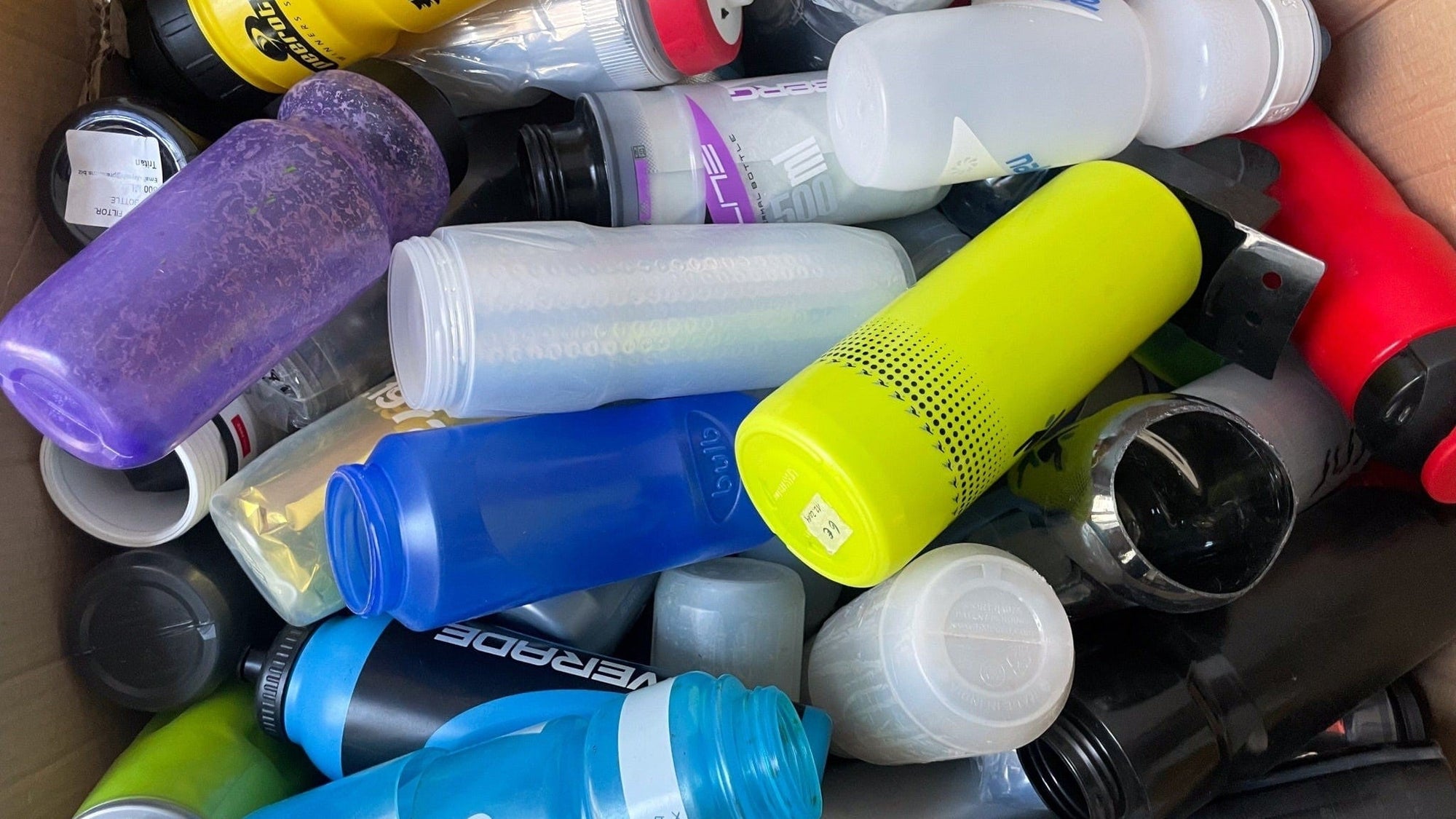
A particularly robust study from Denmark (Tisler & Christensen, 2022) examines precisely these types of sports and cycling water bottles under realistic conditions. The result: hundreds to thousands of chemical substances can be detected in the water—a level exacerbated by use and dishwasher cleaning.
The study clearly shows:
The material is not inert. It reacts, ages, and releases components.
Lessons Learned from "Plastic Detox"
The Netflix series puts these very insights into an accessible context.
A key takeaway:
Plastic isn’t just a waste problem—it’s an exposure problem.
We’re not just surrounded by plastic—we come into direct contact with it every day. Through the air, through food , and especially through the things we use on a regular basis.
A key point:
It’s not individual contacts that matter, but consistency.
The things we use every day become a constant source of inspiration. And that’s exactly why it’s worth taking a closer look at seemingly mundane things—like the water bottle we use when exercising.
Sports as an Underestimated Booster
For athletes, staying hydrated is a daily routine. Several times a day. Year after year.
But it is precisely this routine that makes it unique:
It is used more intensively.
A standard water bottle is opened and closed.
A sports bottle is also squeezed, carried, shaken, exposed to the sun, and cleaned frequently.
Valves and mouthpieces create additional friction.
The material is under constant stress.
And it is precisely these factors that have been identified in research as key drivers:
- mechanical wear
- repeated stress
- Exposure to UV rays and heat
- Cleaning and the dishwasher
This means:
The conditions under which material breakdown and release occur are particularly pronounced in sports.
What actually happens
When plastics "function" under these conditions, the effects are not confined to the material itself.
The following are created:
- released chemical substances
- Metabolites
- and potentially micro- and nanoplastic particles
And they don't stay on the outside of the bottle.
They migrate to areas where there is direct contact:
into the fluid—and thus into our bodies.
This is not a theoretical scenario, but the logical consequence of the observed processes.
KEEGO: A Revolutionary Approach
The squeezable titanium sports bottle called KEEGO was developed based on precisely this consideration. The solution was to modify the material specifically where it matters most: on the inside.
Inside: Titanium—a material that is durable, inert, and tasteless.
Outside: Flexible—so the bottle continues to perform as needed during sports.
This preserves the function while eliminating direct contact between the beverage and the plastic .
Conclusion
Plastic Detox doesn’t mean avoiding plastic entirely.
It means understanding where it matters.
And making more conscious choices in those areas.
When exercising. When drinking. In everyday life.
Because in the end, it’s not just about what surrounds us.
It’s about how we deal with it and how we adjust our routines so that less of it ends up in our bodies.